LLR Books

The typist's tale of 'Last Tycoon'


Years after 'Gatsby,' F. Scott Fitzgerald's secretary got to witness the second act of an author who didn't believe in them.

All these years later, Frances Kroll Ring can still see it, the afternoon she filled out an application at Rusty's Employment Agency on Hollywood Boulevard and drove to Encino to meet a writer who was looking for a secretary.

It was April 1939, and she was 22, a Bronx transplant with typing and dictation skills. She'd been in Southern California for a little more than a year, coming west to help her father, a New York furrier, set up shop on Wilshire Boulevard. "Everybody said, 'You're a furrier? What are you doing in Southern California?' " Ring remembers. "But he knew the studios used furs. Because then the actresses used to be dressed to the gills."

At 92, Ring is elfin: small, spry, dressed in black pants and flat shoes. Her gray hair is short but not close-cropped and when she laughs, which is often, she reveals a toothy grin. Her house on this quiet spring morning in Benedict Canyon is full of books and mementos; a drawing by author William Saroyan hangs on one wall. Sitting at her dining table, sipping coffee, she looks back to the afternoon that started it all.

"At the agency," she recalls, "they asked if I knew Scott Fitzgerald and I said I wasn't really sure. I hadn't read Fitzgerald then. I'd read Hemingway, who was the big muck-a-muck." This was not unlikely: By 1939, 14 years after the triumph of "The Great Gatsby," Fitzgerald had been essentially forgotten, much of his writing out of print. Now he was in Los Angeles to hack it out for the studios, struggling to support his wife, Zelda, institutionalized in North Carolina, and their daughter, Frances, known as Scottie, a student at a boarding school back east. He was an alcoholic recently recovered from a nervous breakdown; he hadn't published a book in four years.

Ring, however, didn't know any of that when she went "over the hill" to where Fitzgerald was living. She also didn't know Fitzgerald was planning his own literary resurrection, a novel that, notes Pulitzer Prize-winning biographer A. Scott Berg, "promised to be his best book." That was "The Love of the Last Tycoon," the Hollywood epic on which Fitzgerald worked, with Ring's assistance, for the last 20 months of his life. Left unfinished at his death in December 1940, the book would be instrumental in rehabilitating Fitzgerald's reputation when it was published in 1941.

"She's the last real witness," Berg points out, "along with Budd Schulberg" (the 95-year-old author of the classic 1941 Hollywood novel "What Makes Sammy Run?") "to Fitzgerald as a working writer. She had a front row seat for a year-and-a-half." Novelist Steve Erickson calls her "a living connection to an American culture that cared about writing and literacy . . . She is the keeper of a literary flame in a city that has always had more literature than it gets credit for."

Ring has, on occasion, told her story; in 1985, she published a slender memoir, "Against the Current: As I Remember F. Scott Fitzgerald," which was made into the 2002 Showtime movie "Last Call." But she's also deeply protective of her time with Fitzgerald -- "she didn't want to seem to be exploiting it," suggests Erickson -- which explains why so few know about his final months.

From the start, Fitzgerald was frail, if focused. He had just returned from a disastrous trip to Cuba with Zelda -- the last time they would see each other -- and was recovering from the bender the voyage had become. "He was lying in bed," Ring says of their first meeting, "and he asked me all kinds of questions. Then he gave me some money and asked me to wire it to his daughter -- and to call him when I was done. That was his way of testing my honesty. He was only in his 40s, but he was fragile. The kind you wanted to help. He was very pale and had very blue eyes, and he was a charmer."

Toward the end of the interview, Fitzgerald asked Ring to open a drawer in his bedroom; "Instead of shirts or underwear or whatever one might expect to find in a bureau drawer, there were gin bottles," she writes in her book.

It's not clear, exactly, whether Fitzgerald was warning her about what she was getting into or letting her know what he was trying to overcome. One possibility is that it was another test, another indication of the need for discretion, of the type of closeness that working with him would require. "He told me he was going to do a novel about Hollywood," Ring says. "That was another thing: Could he trust me? Because he didn't want anyone to know what he was doing."

Fitzgerald wasn't, at first, able to work. "He wasn't organized yet," Ring says. "We did letters. I could type, I could do letters, I could do bookkeeping because I used to take care of my father's stuff. And at the beginning, he wanted to sit and talk. He was in bed most of the time, or he'd get up and pace around. He'd talk about books, and I was well-read, which intrigued him, because a lot of the secretaries were not well-read. There were other functions for them at the time and I wasn't that kind of girl."

Indeed, Ring became something of a surrogate daughter to Fitzgerald, keeping him company, helping him get back into writing shape.

"What's fascinating," muses Berg over the telephone, "is that in the end, here is Scott Fitzgerald, his wife in the asylum, his daughter at school on the East Coast, and he falls in love with another blond and in many ways adopts another girl named Frances -- like his daughter -- and replicates the family. It's spooky to me, eerie, almost like a parallel universe."

The blond was Sheilah Graham, the gossip columnist with whom Fitzgerald began a relationship in 1937. Eventually, he would move into her apartment on Laurel Avenue in West Hollywood, but when he was still in Encino, Graham would visit in the afternoons. "She would roll down her stockings," Ring chuckles. "It was a signal for me to leave."

Although there were, she admits, "drunken periods," mostly it was a time of stability. "He had a daughter to whom he felt total responsibility," she reflects. "He felt he was the one solid family member -- and he was."

This responsibility manifested in a variety of ways, beginning with his work on "The Last Tycoon." As Fitzgerald zeroed in on the novel, he dictated notes and character sketches, outlined chapters and scenes. "The book was meticulously planned," Ring says. "By the time he started to write, he knew who his characters were and what the struggle was between them."

"The Last Tycoon" is the story of Monroe Stahr, a Hollywood boy wonder who Fitzgerald saw as a sensitive soul, artistic even, in a cutthroat business. The key, Ring suggests, was Fitzgerald's notion of the novel as redemptive, a way to make use of everything he'd observed in Hollywood, to take its degradation ("I hate the place like poison with a sincere hatred," he wrote to his agent in 1935) and transform it into literature.

Fitzgerald wrote "on long sheets of paper," Ring remembers, "yellow pads. He had a big, scrawling hand. I would type it up triple-space. And then he would redo it." He worked all the time: on the novel; on various film projects, including an adaptation of his own "Babylon Revisited"; and on the 17 "Pat Hobby Stories" that he wrote for Esquire, which were published, beginning in January 1940, at $250 apiece. In his introduction to "The Pat Hobby Stories," collected as a book in 1962, Esquire editor Arnold Gingrich quotes from the many wires Fitzgerald sent seeking payment: "Again the old ache of money," the author writes. "Again will you wire me, if you like it. Again, will you wire the money to my Maginot Line: The Bank of America, Culver City."

Partly, this had to do with his commitments to his wife and daughter, spread out across the country like distant satellites. "He never could get to the book," Ring says, "because he constantly needed money. He'd knock out a short story and then he'd get a week at a studio, sometimes two weeks. He couldn't turn it down."

Yet, the sheer volume and quality of the work he was doing says something else about Fitzgerald, putting the lie to the myth that he burned his talent out. Rather, the last 20 months of his life represented a creative resurrection, a rebuttal to the author's own assertion, in the pages of "The Last Tycoon," that "there are no second acts in American life."

In fact, Ring continues, Fitzgerald was fiercely aware of his reputation, of the split between the work he was doing and the way the culture had passed him by. "He would get angry if he got rejected by an editor at Collier's who he had no regard for," she says. "He would go crazy. He was essentially a gentle man, but he would get so furious at being rejected. But his strength was that he didn't give up. A lot of guys would have gone to seed. He went to drink, but he controlled the drink. The work was more important than the drink."

Some of this toughness, it seems, wore off on Ring; she took care of the details when Fitzgerald died of a heart attack at age 44 on the Saturday before Christmas 1940, at Graham's apartment, where he'd moved after having had a first heart attack a few months before. "I had to arrange," Ring says, "for the body to be shipped back because the funeral was back east. He was alone out here. Sheilah was not that kind of help. She was hysterical. By some odd quirk, he had put away $700 in cash, which he told me about; the payment for the burial and the coffin came to just under $700. I always thought he must have called at one point to find out, that he lived with a premonition of death, in a sense."

Then, in 1941, she faced down the formidable critic Edmund Wilson over the posthumous edition of "The Last Tycoon," critiquing his summary of the book's unfinished chapters and arguing that "a few colorful background facts will make Stahr more memorable even though so much of the novel has to peter out in synopsis form."

These experiences served Ring well; in the 1940s, as a reader in the story department at Paramount, she was arrested for picketing during a divisive eight-month Hollywood strike involving the Conference of Studio Unions.

She was married at the time, but 25 years later, after the death of her husband, she reinvented herself as the editor of Westways, the magazine of the Automobile Club of Southern California, which she built into a powerhouse, publishing Saroyan, Carey McWilliams and Anaïs Nin.

Listening to Ring now, it's impossible not to imagine the young woman she must have been, as if in death Fitzgerald had left her to be his advocate. Such a feeling lingers. The connection feels almost physical, distinct in its own way from space and time. It's not that Ring is living in the past -- she isn't -- but that here at the top of Benedict Canyon, the past is somehow present, the borders are porous.

The sensation grows when Ring mounts the stairs to the second floor, where in a small office are three first editions ("Tender Is the Night," "Taps at Reveille" and "The Great Gatsby") that Fitzgerald inscribed to her, as well as a King James Bible he gave her father for having recut a fur coat for Scottie in the style of the time.

Ring takes up the books one by one, reads aloud the inscriptions. "This one is my favorite," she says, holding open "Taps at Reveille":

Frances Kroll

She has a soul

(She claims to know it)

But when young Frances

Does her dances

She don't show it.

From the bald headed
man in the front row,

Scott Fitzgerald

"The Gayieties"

1939

But it's the Bible that provides an unexpected coda, bringing Fitzgerald into the room in an almost three-dimensional rush. The book is boxed, although the box has long since broken and is held together with a rubber band.

Slowly, carefully, as if she were invoking her two fathers -- one physical, the other figurative -- Ring opens it and removes a letter, written in pencil and folded into an envelope.

It's a note of thanks:

"Dear Mr. Kroll, I want to add my thanks to Scottie's for the beautiful cutting of the coat. It is perfectly magnificent and we are so happy to have it. Not having seen her for fourteen months, I took pleasure in imagining her face when she got it -- her surprise and delight.

"It was a grand Christmas present, much greater than I would have been able this year to give her myself. . . .

"With all good holiday wishes."

After the signature, there's a P.S.: "The pencil is the result of writing in bed for the present."

"He always had to do that," Ring says, laughing softly, "to put that little tag on. To draw attention to his illness. He was a hypochondriac." She pauses. "But this time it was true. He didn't have the energy. This was Dec. 14, just a week before he died."

The room grows close, quiet. You can almost feel Fitzgerald there. The pencil marks on the unlined paper look so fragile, vulnerable even, and in them is contained everything he was up against.

"I was invested in Fitzgerald," Ring says, refolding the letter. "Because you couldn't be with him and not know how desperately he wanted to write another good book. He was out of it, and he was just too good to be out of it."


Scott Fitzgerald's flask, on the anniversary of his death


Seventy years ago today, F. Scott Fitzgerald died after having a heart attack in his girlfriend's apartment in West Hollywood. It was his second heart attack in a few short months; he was 44.

Fitzgerald is, of course, the author of "The Great Gatsby," the lasting novel of American ambition, hubris, wealth and failure. In his lifetime, Fitzgerald saw both great success and great disappointments -- most of his books were out of print when he died. Yet today, many of his works are important: "Tender Is the Night," "Tales of the Jazz Age," "This Side of Paradise," even "The Last Tycoon," which was unfinished when he died.

Open Culture has posted an audio recording of Fitzgerald reading the John Keats poem "Ode to a Nightingale," which one scholar thinks was recorded in Fitzgerald's last year, "perhaps in a self-recording phonograph booth in Southern California."

The recording comes from the Fitzgerald Collection at the University of South Carolina. The collection comprises 12,000 items assembled by Fitzgerald scholar Matthew Bruccoli. Among its more unusual items are a briefcase with Fitzgerald's name stamped into the leather, a signed copy of "Ulysses" with a note to Fitzgerald from James Joyce and a flask, inscribed:

To 1st Lt. F. Scott Fitzgerald
 65th Infantry
 Camp Sheridan

Forget-me-not
 Zelda
 9-13-18
 Montgomery, Ala

In 2009, David L. Ulin talked with Frances Kroll Ring, Fitzgerald's last secretary, now in her 90s. "He told me he was going to do a novel about Hollywood," Ring says. "That was another thing: Could he trust me? Because he didn't want anyone to know what he was doing." She also noted, "He was very pale and had very blue eyes, and he was a charmer."

Previously unpublished F. Scott Fitzgerald story is in New Yorker


July 30, 2012, 7:25 a.m.

A previously unpublished story by F. Scott Fitzgerald appears in this week's issue of the New Yorker. The magazine had originally rejected the 1936 story, "Thank You for the Light," when it was submitted by the author.

"Thank You For the Light" is a tiny, short story about Mrs. Hanson, "a pretty, somewhat faded woman of forty, who sold corsets and girdles." When she's transferred to a new territory, her smoking habit is frowned upon, and all she wants is to have a cigarette. It has a tidy ending, but more important to the story is Mrs. Hanson's longing as she wishes for the cigarette she can't smoke.

Is it secretly about Fitzgerald and drinking? You decide.

By the mid-1930s, Fitzgerald was suffering difficulties. After the publication of his first novel, "This Side of Paradise," he'd been the toast of New York. The New Yorker, which published its first issue in 1925, welcomed him in its pages: He had three stories and two poems published in the magazine between 1929 and 1937. But it also chronicled what it saw as his dissipation.

The New Yorker's Book Bench shares part of a 1926 profile by John C. Mosher of Fitzgerald and his wife, Zelda. "[His] popularity on two continents may explain something of the financial mystery which so appals him. Ever since 'This Side of Paradise,' money has poured in upon this young couple, thousands and thousands a month. And just as fast it has poured out. Where it goes, no one seems to know. Least of all evidently, the Fitzgeralds. They complain that nothing is left to show for it. Mrs. Fitzgerald hasn’t even a pearl necklace."

Fitzgerald moved to Southern California in the late 1930s and worked as a screenwriter in Hollywood. He was not well; he died of a heart attack at age 44. When he died, he left the novel "The Last Tycoon" unfinished, and most of his novels were out of print.

Now, of course, Fitzgerald's "The Great Gatsby" is considered the great American novel. It will be coming to movie screens this winter, courtesy Baz Luhrman, in 3-D.


Writing Advice from F. Scott Fitzgerald

Piece of advice published on Letters of Note. It’s from F. Scott Fitzgerald to the aspiring writer at the time, Frances Turnbull, who sent him a story for comment while she was a student at Radcliffe. (The Turnbulls owned a summer house called La Paix, which Fitzgerald rented in 1932-1933 and where he wrote portions of “Tender Is the Night.”)
Fitzgerald’s advice here is wonderful, especially for new writers. He tells her “You’ve got to sell your heart, your strongest reactions, not the little minor things that only touch you lightly, the little experiences that you might tell at dinner.”
And
“…literature, even light literature, will accept nothing less from the neophyte. It is one of those professions that wants the ‘works.’ You wouldn’t be interested in a soldier who was only a little brave.”
Interestingly enough, in the post script, he tells Frances that she has talent, but tells her that is not enough. That reminded me of the post I wrote back in May, “Do You Have Talent?,” which makes the case that talent is just one thing a writer needs — but not the only thing.

Where Daisy Buchanan Lived


In a 1940 letter to his daughter written six months before his death, F. Scott Fitzgerald said, “Once I thought that Lake Forest was the most glamorous place in the world. Maybe it was.” Sixty-six years later, as I drove through the Illinois suburb that sits thirty-two miles north of the heart of Chicago’s Loop, I kept looking around and wondering to myself what exactly it was that Fitzgerald found so great. I thought about him as I drank a coffee at a Starbucks that wasn’t there the last time I’d visited, and I noticed that the McDonald’s drive-through near the Metra train station seemed to be buzzing. All the suburban trappings I recalled from a childhood spent on the North Shore of Chicago were still there. To me, Lake Forest was a place I’d gotten to know by peeking through frosted car windows on my way to early morning hockey practice as a kid. Cozy, definitely, but not exactly the sort of place I associate with the Roaring Twenties decadence and wild parties conjured by Fitzgerald’s name.

Founded in 1861, Lake Forest, Illinois, was originally built as a college town by Presbyterians. After the Civil War, the city attracted residents whose last names were synonymous with the building (and a decade later, the post–Great Fire rebuilding) of Chicago. Thanks to its tranquility and natural beauty, as well as its isolation from main roads, Lake Forest became the Chicago metropolitan area’s most desirable neighborhood, attracting Rockefellers, Armours, Medills, and Marshall Fields. Lake Forest was the Greenwich of the Midwest: a haven for robber barons and meat packers far from the strikes, riots, and muckrakers that threatened the wealth and safety of the early twentieth century’s 1 percent. By the city’s 150th anniversary, in 2011, Lake Forest had served as the setting for a best-selling novel (A Heartbreaking Work of Staggering Genius, by native son Dave Eggers) and Oscar-winning film (Robert Redford’s Ordinary People). But the city’s first true claim to literary fame came in 1925, as a passing mention in the first chapter of The Great Gatsby, in which we learn from narrator Nick Carraway that Tom Buchanan has bought a string of polo ponies from Lake Forest. Carraway is amazed that a man of his own generation is wealthy enough to have done so.

Fitzgerald’s repeated mentions of Lake Forest in his work is not much commented on; it isn’t associated with him the way Princeton University, Long Island, and the South of France tend to be. Indeed, the casual mention in Gatsby might lead one to believe that it was just a city he’d read about or a place he saw on a map. But it’s something more than that. The reason Lake Forest became such a significant place to one of America’s great writers is simple: his first love was from there.

Ginevra King met Scott Fitzgerald for the first time on January 4, 1915, while visiting a school friend in Minnesota. The two began a romance that consisted primarily of written correspondence, until it was broken off in 1917. While a two-year letter writing campaign might not seem like much by today’s standards, it clearly made an impression. Several of Fitzgerald’s best-known female characters were based on a composite partially inspired by King and her letters: from Judy Jones in the short story “Winter Dreams” to Isabelle Borge in This Side of Paradise. The poor boy losing the rich girl is a common theme in Fitzgerald’s work, and the original model was surely his relationship with King. King’s influence is also present in the iconic character of Daisy Buchanan—Jay Gatsby’s obsession and one of Fitzgerald’s most memorable creations.
King
In the years leading up to World War I, King and her three closest friends—Margaret Carry, Courtney Letts, and Edith Cummings—were considered celebrities in Lake Forest and, indeed, throughout the Chicagoland area. Collectively known as the Big Four (a name they bestowed on themselves), they were the socialites of their era. The exclusive group didn’t allow new members, and each wore a rose-gold pinkie ring with The Big Four 1914 engraved on the inner band. They rarely went out in public without each other, were either loved or reviled by everyone who knew about them, and, with the brashness of the young and rich, didn’t care about what anybody thought. As if Gatsby’s one tie to Lake Forest wasn’t enough, Cummings, who in 1924 became the first golfer and female athlete featured on the cover of Time, is a reasonable culprit for the inspiration behind the sassy and dishonest golfer, Jordan Baker
As with any truly great book, everybody who loves Gatsby comes away with certain ideas of what the novel is really about. You can’t help but attach meaning to parts of the book in an attempt to understand things: Was Gatsby a Jew? What’s the deal with the green light? Is it a book about the American Dream or is it mocking the very concept? Gatsby is the type of classic that deserves to have conclusions drawn about it by scholars and casual readers alike. And as soon as I learned about Fitzgerald’s Lake Forest past, I was reading a book about him and Ginevra King. Fitzgerald wrote the chunk of the book that takes place on Long Island while living on Long Island with Zelda by his side, but it seemed to me that The Great Gatsby could have just as easily have been set in Lake Forest.
According to King’s diaries and letters to Fitzgerald (which are available to the public at Princeton University), the young writer first visited her in Lake Forest late in June 1915. The trip was brief, but Fitzgerald surely admired the beauty of the affluent city. He wouldn’t have missed Edith Rockefeller McCormick’s Villa Turicum—the lakefront estate (situated on three hundred acres) designed by Charles Platt and inspired by Edith Wharton’s Italian Villas and Their Gardens—and surely visited the public lawns manicured to resemble English gardens that he would later recall, in another “Ginevra story,” “A Nice Quiet Place,” as “immaculate.” He returned again the following summer. This time he had a bit more time to see Lake Forest and observe the culture. Since Fitzgerald’s own hometown in Minnesota mostly comprised the nouveau riche, his time spent in Lake Forest was perhaps his first exposure (not counting rowdy days at Princeton) to old money’s natural habitat. If that is indeed the case, the city that stretches out along Lake Michigan shaped the writer’s view of how the other half lived, and any fan of Fitzgerald knows that the lifestyles of the rich (both old and new) were fixations in his work. And it could be mere coincidence, but Lake Forest is part of the group of Chicagoland lakefront cities known as the North Shore; Gatsby’s West and East Egg, based off the Long Island cities of Great Neck and Sands Point, are also on a part of the island referred to as the North Shore.

Villa Turicum
There are some that believe King and Lake Forest may have even helped Fitzgerald come up with the initial idea for Gatsby. In his 2005 book, The Perfect Hour, which attempts to piece together King’s relationship with Fitzgerald, James L. M. West III points to a story that she wrote and shared with Fitzgerald in 1916. West suggests that Fitzgerald may have used the untitled piece “in search of material and inspiration,” pointing out a handful of similarities between King’s somewhat crude short story and Fitzgerald’s masterpiece. West also points out that the story makes clear that King was aware of Fitzgerald’s habit of observing her and her friends; one of her characters, a writer named “Scott Fitz-Gerald” keeps a card file on his old girlfriends. Indeed, Fitzgerald’s writing process sometimes involved him scouring old letters and journals in order to jog his memory or kick-start his creative drive. One batch of documents may have included a 227-page binder filled with transcripts of King’s letters, which she had asked him to destroy in a letter on July 7, 1917. The first page of the batch reads, “Strictly Private Letters: Property of F. Scott Fitzgerald (Not Manuscript).”

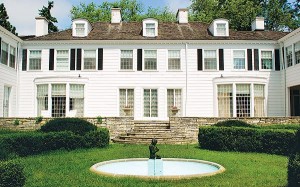
Kingdom Come Farm, today.
I visited Lake Forest again last year and thought more about Fitzgerald and King. I grabbed a coffee at the Starbucks that didn’t seem so new anymore, I ate lunch at a restaurant with three different autographed Vince Vaughn photos (another favorite son of the city), and I reread Gatsby before crashing on a friend’s couch in nearby Evanston. I tried to picture this writer, of whom I’ve only seen about a dozen photographs, sitting at his desk thinking of Lake Forest and the girl he once knew from there. The next day I got into a car and took the only thing resembling a literary pilgrimage I’ve ever taken in my life, as I drove through the city trying to experience what Fitzgerald had experienced. I looked out over the bluffs that faced Lake Michigan, trying to imagine a fabulous West Egg party taking place there. I tried to picture Meyer Wolfsheim making a stop in Lake Forest after he met with Chicago associates, and I envisioned Jordan Baker teeing up as I passed by the Onwentsia Club where King and her three friends were regulars. And when I caught a glimpse of the property once known as Kingdom Come Farms that was owned by King’s father, and, no doubt, hosted Fitzgerald at least once, I tried to imagine Gatsby pulling up in a yellow Rolls Royce, hoping to impress the girl who changed his life when he was a much younger man.

F. Scott Fitzgerald at the Cavalier Hotel -1927


For years, the photo below has circulated among F. Scott Fitzgerald, (author of the Great Gatsby) fans leaving them without any type of descriptive information concerning this wonderful family portrait.


Today, we are happy to finally give this photo the proper credits and to provide fans of the Fitzgerald’s with some additional information.
The photo was taken by the Tidewater photo service in Virginia Beach at the Cavalier Hotel swimming pool in July of 1927 and first published in the Norfolk Ledger Dispatch on July 18, 1927.
Here is a close-up of the photo as it ran in the newspaper 85 years ago yesterday afternoon –
The Tidewater photo service was based at 207 Granby St. in Norfolk, Va. and had a branch office at 205 17th St. in Virginia Beach. Their motto was “Portraits that Please”.


Here are telegrams sent to and from F. Scott Fitzgerald while he, Zelda and Scottie Fitzgerald were visiting Hampton Roads. They are dated between the 14th of July and the 21st of July.
Some were sent to and from the Cavalier Hotel and another to a wire office in Norfolk. It is possible that F. Scott and his family were visiting one of his favorite cousins in Norfolk- ''Cousin Cecie'' (Mrs. Richard Calvert Taylor) who lived on the corner of Gosnold and Carolina streets in Norfolk’s Colonial Place.


The Fitzgerald’s returned to America from France in December of 1926 with F. Scott spending some time in Hollywood beginning in January of 1927. They began renting their mansion “Ellerslie,” near Wilmington, Delaware in March of 1927 – so a quick vacation down to the Cavalier in July would be quite convenient.
The Cavalier Hotel had its grand opening in April of 1927 – so the Fitzgerald’s were some of the first celebrities to stay at this grand hotel on the Atlantic.


Zelda


“I don’t suppose I really know you very well – but I know you smell like the delicious damp grass that grows near old walls and that your hands are beautiful opening out of your sleeves and that the back of your head is a mossy sheltered cave when there is trouble in the wind and that my cheek just fits the depression in your shoulder.” Zelda